
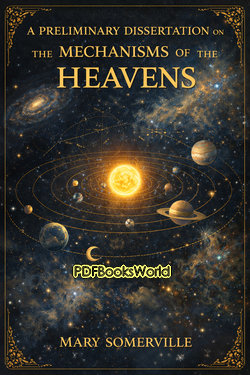
A Preliminary Dissertation on the Mechanisms of the Heavens
by Mary Somerville
Making the Universe Understandable for a New Generation of Readers
A Preliminary Dissertation on the Mechanisms of the Heavens by Mary Somerville is a landmark work in the history of science communication. Written as an introduction to advanced astronomical concepts, the book explains the principles governing the motions of planets, moons, comets, and other celestial bodies. Somerville's achievement was not merely her mastery of complex mathematics and astronomy, but her ability to present these subjects in a clear and accessible manner for educated readers who lacked specialized scientific training.
At a time when scientific knowledge was becoming increasingly sophisticated, Somerville helped bridge the gap between professional researchers and the general public. Her work contributed significantly to the popular understanding of astronomy and established her reputation as one of the most respected scientific writers of the nineteenth century.
Understanding the "Mechanisms of the Heavens"
The phrase "mechanisms of the heavens" refers to the laws and principles that govern the movements of celestial bodies. Astronomers had spent centuries studying why planets orbit the Sun, why moons circle planets, and how gravity influences the structure of the universe.
Somerville sought to explain these phenomena in a way that revealed the elegance and order underlying the cosmos. Rather than viewing the heavens as mysterious or unpredictable, she presented them as systems operating according to discoverable natural laws.
The Influence of Newtonian Science
A major foundation of the book is the work of Sir Isaac Newton, whose laws of motion and theory of gravitation transformed humanity's understanding of the universe. Somerville carefully explains how gravitational attraction influences planetary motion and helps maintain the stability of the solar system.
Central to these ideas is the relationship described by Newton's law of gravitation:
By discussing concepts such as gravity, orbital motion, and celestial mechanics, Somerville helped readers appreciate the mathematical harmony that scientists observed throughout the universe.
Bringing Complex Science to a Wider Audience
One of the book's greatest accomplishments is its accessibility. Scientific works of the period often assumed extensive mathematical knowledge, making them difficult for general readers. Somerville translated complicated ideas into clear explanations without sacrificing accuracy.
Her writing demonstrated that advanced science could be understood by curious and dedicated readers outside academic institutions. This approach greatly expanded public interest in astronomy and mathematics.
Major Topics Explored in the Work
- Gravity: The force governing the motion of celestial bodies.
- Planetary Orbits: The paths followed by planets around the Sun.
- Celestial Mechanics: The mathematical study of motion in the universe.
- Astronomical Observation: How scientists investigate and understand the heavens.
These subjects provide readers with a comprehensive introduction to nineteenth-century astronomical science.
Mary Somerville's Legacy
Mary Somerville was one of the most remarkable scientific figures of her era. At a time when opportunities for women in science were limited, she earned international respect through her scholarship and writing. Her ability to explain difficult concepts made her a pioneering science communicator whose influence extended far beyond academic circles.
Her achievements inspired future generations of scientists, educators, and writers. Today she is remembered not only for her scientific knowledge but also for her role in making that knowledge accessible to others.
Why the Book Was Historically Important
- Scientific Education: Helped introduce advanced astronomy to a broader audience.
- Clear Explanations: Made difficult concepts understandable without oversimplification.
- Historical Significance: Reflected the state of astronomical knowledge in the nineteenth century.
- Pioneering Authorship: Established Somerville as one of the leading scientific writers of her time.
The book played an important role in spreading scientific literacy during a period of rapid intellectual progress.
Why A Preliminary Dissertation on the Mechanisms of the Heavens Remains Worth Reading
A Preliminary Dissertation on the Mechanisms of the Heavens remains a remarkable achievement in scientific writing. Through her clear explanations of gravity, planetary motion, and celestial mechanics, Mary Somerville opened the wonders of astronomy to countless readers. The book stands as both an introduction to the science of the heavens and a testament to the power of effective communication in expanding human understanding of the universe.
Similar Genres
About the Author
Mary Somerville was a Scottish mathematician, astronomer, science writer, and one of the most respected scientific communicators of the nineteenth century. At a time when women faced significant barriers in higher education and scientific research, she earned international recognition for her remarkable ability to explain complex mathematical and astronomical concepts with clarity and precision. Explore Mary Somerville books to discover the author's life, literary career, and access notable works.