
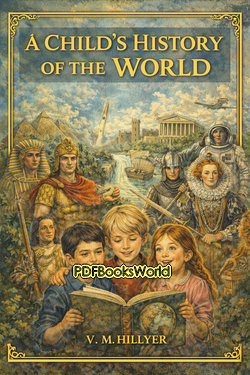
A Child's History of the World
by V. M. Hillyer
A Popular Introduction to World History for Young Readers
A Child's History of the World by V. M. Hillyer is a classic educational book that presents the story of human civilization in a clear, engaging, and accessible manner for young readers. First published in 1924, the work became one of the most widely read introductions to history for children, guiding generations through major events, cultures, discoveries, and historical figures from ancient times to the modern era.
Hillyer approaches history as a grand narrative rather than a collection of dates and facts. His conversational style encourages curiosity and helps readers see connections between different peoples, places, and periods of time. The result is a lively overview of the human story that remains appealing long after its original publication.
History Told as a Story
One of the book's most distinctive features is its storytelling approach. Instead of overwhelming readers with detailed political events or technical information, Hillyer presents history as an unfolding adventure involving explorers, rulers, inventors, builders, and ordinary people.
This method makes historical events easier to understand and helps young readers develop a lasting interest in the past.
A Journey Through Civilizations
The book travels across continents and centuries, introducing readers to ancient Egypt, Mesopotamia, Greece, Rome, medieval Europe, Asian civilizations, the Age of Exploration, and many other important periods. Hillyer seeks to show how different cultures contributed to the development of human society.
By examining a wide range of civilizations, the book encourages a broader understanding of world history.
Highlights of the Book
- Global Scope: A survey of civilizations from ancient times onward.
- Accessible Style: History presented in simple, engaging language.
- Famous Figures: Introductions to influential leaders, explorers, and thinkers.
- Historical Connections: Linking events across different eras and regions.
- Educational Value: An introduction designed specifically for younger readers.
Learning Through Curiosity
Hillyer believed that children learn best when their curiosity is encouraged. Rather than focusing solely on memorization, he invites readers to ask questions and imagine what life was like in different times and places. This approach transforms history into a subject filled with discovery and adventure.
The book's enduring popularity owes much to this ability to make learning enjoyable.
Major Themes
- Human Progress: The development of societies over time.
- Exploration: Discovering new lands and ideas.
- Innovation: Advances in knowledge, technology, and culture.
- Cultural Exchange: Interactions among different civilizations.
- Education: Understanding the past to better appreciate the present.
V. M. Hillyer's Educational Vision
Virgil Mores Hillyer was an educator who sought to make learning enjoyable and meaningful for children. His writing emphasizes clarity, enthusiasm, and broad understanding rather than excessive detail. Through this approach, he helped many young readers develop an early appreciation for history and geography.
His ability to communicate complex historical subjects in an engaging manner contributed greatly to the book's success.
Why the Book Remains Important
A Child's History of the World remains a beloved introduction to history because it combines education with storytelling. While modern scholarship has expanded and revised many aspects of historical interpretation, Hillyer's work continues to be admired for its readability and its success in inspiring interest in the past.
For young readers, parents, and educators seeking an engaging overview of world history, the book offers a memorable journey through humanity's shared story. Its spirit of curiosity, learning, and exploration ensures its enduring place among classic educational works.
Similar Genres
About the Author
V. M. Hillyer was an American educator and author best known for making history enjoyable and accessible for young readers. He believed that children could better understand the past when historical events were presented as engaging stories rather than a collection of dates and facts. His writing combined careful research with a conversational style that encouraged curiosity and lifelong learning. Explore V. M. Hillyer books to discover the author's life, literary career, and access notable works.